
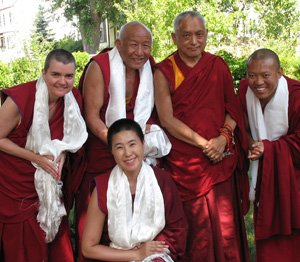
 Tibetan Buddhism teaches us that each and every person has the ability to reach their highest potential and that this is achieved through working with the mind. Through cultivating the wish to benefit and not harm others, we can transform thoughts and actions, improving our life and creating a better world. This is accomplished through listening to teachings, study, contemplation and meditation. We investigate the way things are, identify obstructions in our lives, and accustom our minds to new and more effective habits. Buddhism began in India 2,500 years ago, and after developing there for over 1,000 years, it was then brought across the Himalayas to Tibet, where it became an inextricable part of the culture, flourishing for centuries. After the Chinese Communist occupation of Tibet in 1949, Tibetan Buddhism began to emerge from its mountainous sanctuary and its techniques and philosophy have since spread throughout the world.
For more information about Tibetan Buddhism, go to Frequently Asked Questions on theFPMT website.
CELEBRATIONS & TRADITIONS
Losar – Tibetan New Year
Losar is the most important festival in Tibet. This year, Losar, the Tibetan New Year, occurs on Friday, February 12 and ushers in the Year of the Iron Ox. The first two weeks of the New Year, also known as the Fifteen Days of Miracles, commemorate a period of time in which Shakyamuni Buddha uncharacteristically displayed his power by performing a number of miracles in order to win over hundreds (if not thousands) of disciples from a teacher who was a non-believer of the Buddha’s teachings. This teacher challenged the Buddha to a dual of mystical powers, and at the end of the two week period, the Buddha had clearly won the match. As a result, all present converted to the practices taught by the Buddha.
The new year marks a time of great increase in virtuous activity amongst Buddhist practitioners. Any actions done during this period of time, for better or worse, are multiplied exponentially in their power by virtue of being in alignment or out of alignment with the great deeds the Buddha himself did during this same astrological period over 2,500 years ago. It is a very powerful time to practice and increase one’s commitment to both practice and study, as the blessings of that magical event can be harnessed to assist in our personal evolution towards enlightenment.

Sakadawa
Any actions done on this day, both auspicious and harmful, are magnified in their power. Karmic results are multiplied by one hundred million, as cited by Lama Zopa Rinpoche in the vinaya text “Treasure of Quotations and Logic”. This year, Saka Dawa takes place on June 17. Practices specifically recommended by Lama Zopa Rinpoche for merit multiplying days can be found here:
